 As you know in recent weeks the upcoming battle has become public.
The CEO has been lambasting 'a small group' of controllers as the reasons for all his ills.
He has called them (or at least the sub editors have) various words including, militants, renegades and shirkers.
In what now is a very public battle, apparently all the TIBA lies at the hand of a small group of employees who originally were refusing to work overtime, but now are also 'spiking' their sick leave. In other words, taking fraudulent sick leave to cause maximum damage.
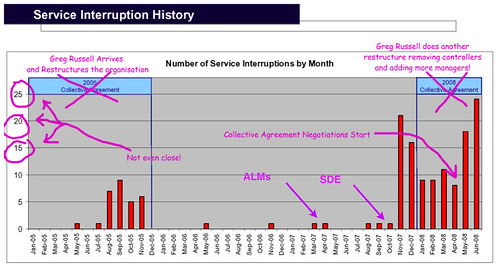
But what is the truth? How much sick leave is actually covered by overtime? How much overtime is used to cover "HOLES IN ROSTERS"? Is sick leave on the rise at all? If it is rising, is there a link between working harder when at work and having less days off a month?
We have evidence that some groups have as many as 30 shifts each month, and that is at the roster 'population' stage, that need coverage with overtime. THAT IS BEFORE ANYONE HAS CALLED IN SICK.
So in that particular group, of the 15 employees they each have to work 2 shifts of overtime each, before anyone calls in sick to cover the core roster. Not bad for a roster that gives most people 10 days off a month. The average sick leave across the ATC workforce is unknown. Recently it was about 12 days a year; much more recently it's been 4 times the national average (36), or three times (27), or three times the national benchmark of 6 (18). But let guess it's close to 12; or one day a month. So talking of that particular group, 15 shifts will also need to be covered because of sick leave. A total of 45 shifts or 3 shifts each.
The expectation is that the overtime will be shared equally. This is far from reality as we all know that we have different work/life balances. We can also surmise that as a result of our rostering processes that most of the shifts (at least 30) of them are in the middle of the night; which are the most difficult to cover; who want's to work a night shift in the middle of two days off; it effectively counts against both days off, so you end up with 20 odd hours between shifts, but NO DAYS OFF AT ALL.
So how did it get this bad?
We here at Certified Shafting have concluded that it's not the fault of renegades and militants. It's totally at the hands of management.
In particular the CEO Greg Russell, who's sycophants implemented the SDE without any consequential thought about whether the idea was good or not.
Long term we can see benefit in the SDE, in terms of keeping jets away from lighties, and changes to airspace classifications in the future in terms of training resources. But what was the rush?
We have burnt countless good will and inherent efficiencies that the previous structure had built in through years of amendment. Prior to SDE in late 2007, the sector structure has been effectively unchanged since 1995; with the exception of minor amendments associated with transitioning to TAAATS. These sectors and rosters had been subjected to significant reforms in that time in terms of roster lines required and (mostly) efficient procedures, refined over that time.
SDE was effectively a clean slate (yeah right). It was predicated on the myth that standardisation exists, which it doesn't. It is a flawed concept in that CITY PAIRS were used to determine the airspace design and structures; with pertinent exceptions from the model; leading to significant inefficiency and complications.
SDE split rosters.
SDE split people who had multiple ratings into small groups with isolated roles.
The above group, went from 19 Staff requiring 6 people on any given shift, to 15 on one side needing 5 on a given day and 12 requiring 4 on a given day. One group of 19 people that used to run efficiently now need 27 staff. This was done in the name of efficiency. WTF?
It was pointed out by middle management that we shouldn't proceed with SDE on the original time lines. This was rejected by senior management as 'politically unacceptable".
These new groups now required night shift coverage; this group used to have 2 night shift staff; now it has 4. Is there any wonder that night shift coverage has become an issue?
The extra 8 people didn't suddenly appear. Most of the holes in rosters were covered by overtime; initially it was accepted with grace; but it was soon clear that the staffing problems were going to exist for a significant period of time, people got sick (quickly) of being called every single day off to come to work, our informant tells us that it was not uncommon to get multiple calls every day.
Then when you were at work, it was likely that you didn't have a full complement of staff on most days; single person duty was (and is) relatively common. So minimum staffing was three but only one controller was on duty; funnily enough this had a propensity to increase your unavailability to work on subsequent shifts; because you were going home far too knackered. If you were called on your day off; it was likely that you'd be subjecting yourself to short staffing rostering again too, thus it was not a 'normal shift' you were replacing but a "super shift"; and one you were less likely to accept.
This was not isolated to one group, but every group initially up the ECS line; now we head towards further implementation with RS and UAS groups also making amendments into the SDE environment.
It is not surprising at all to us that SDE has been a significant failure. It was rushed, it was not resourced properly, it was warped into something unrecognisable from the original intent.
All resistance to SDE was treated as an industrial issue and objectors were dismissed as 'wankers' who didn't get it. We are past the point of no return, but how can we get out of this bucket of shit? And will the solution be for the CEO to blame controllers for not coming to work?
Well now 10 months into SDE, where rosters are still short, we ask was it a good idea?
GREG, was it? Please respond, we'll leave your comment here unmoderated.


